
How long should a homeschool day actually be?
Far shorter than a school day, and not because anything is being skipped. A classroom day is mostly not instruction. It is transitions, attendance, settling twenty-eight children, repeating directions, and waiting for the slowest and the fastest to arrive at the same place. Remove that and the teaching that remains is surprisingly small.
I taught in primary classrooms before I started reviewing activities for Kiddalou, and this is the part that new homeschooling parents almost never believe until they try it.
What a school day is actually made of
Picture a forty-five-minute lesson. Children arrive from somewhere else and settle. Materials go out. The teacher gives an instruction, then gives it again for the ones who missed it, then again individually for two more. Some children finish in eight minutes and need something else; some are still on the first question at thirty. At the end, everything is packed away in time to move on.
The teaching inside that block is real. It is also nowhere near forty-five minutes.
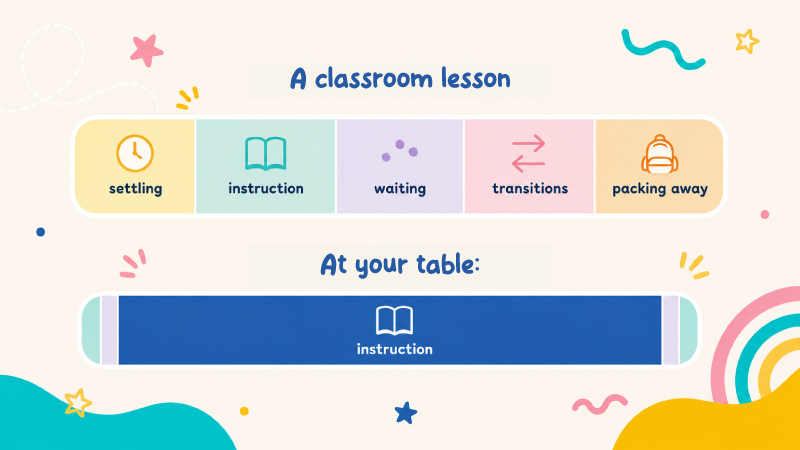
None of this is waste. It is the unavoidable cost of moving a large group of children through a shared task, and a good teacher spends years getting efficient at it. But it is overhead, and at a kitchen table with one or two children, almost all of it disappears.
That is why a homeschooling parent who works for two focused hours has often covered what a school day covers. You are not running a shorter version of school. You are running the same instruction without the crowd.
What this looks like by age
These are the ranges most homeschooling families settle into. They are practice, not research findings, and every child sits somewhere on a spread.
Ages 4 to 6. Thirty to sixty minutes of focused work across the whole day, and it should be split into two or three short blocks, not one sitting. Reading aloud together does not count against this and can run much longer.
Ages 7 to 9. Ninety minutes to two and a half hours, in blocks of twenty to thirty minutes with real breaks between them.
Ages 10 to 12. Two and a half to four hours, with longer individual blocks and more independent work.
If you are hitting the top of your range every day and it is a fight, the problem is almost never the child’s capacity. It is that the sessions have outlasted the attention, which is a different thing entirely. I wrote about the distinction in how long a five-year-old can actually concentrate.
The legal part, honestly
Some states require a minimum number of instructional days or hours per year. Others require none at all. The variation across the fifty states is enormous, and it is the one part of this you should not take from an article.
Check your own state’s department of education directly, or a homeschool legal organization that tracks your state specifically. Do not rely on what a friend in another state does, and do not rely on a blog, including this one.
One thing worth knowing if your state does count hours: read the definition carefully. Requirements are generally written around instruction, not around a child sitting at a desk, and reading, museum trips, and project work frequently count. Parents often log far fewer hours than they have actually delivered because they only counted the worksheets.
The three-hour trap
The most common mistake I see in a first year of homeschooling is recreating the school day at home. Six hours, subject blocks, a bell schedule pinned to the wall.
It collapses within a month, and it collapses in a specific way: the parent concludes they are failing, because they cannot sustain something that was never necessary. What they were actually doing was importing the overhead of a system built for thirty children into a room with two.
Signs you are in it:
- Work is being stretched to fill a block rather than the block ending when the work does.
- There is a subject nobody enjoys that appears daily because the timetable says so.
- Your child finished in twenty minutes and you found something else for them to do, for reasons of schedule rather than learning.
- Everyone is exhausted and the actual output would fit on two pages.
What fills the rest of the day
This is the question underneath the question, and it is the one that makes people nervous. If focused work is two hours, what happens to the other six?
The honest answer is that it is not a hole to plug. Reading, being outside, cooking, building, being mildly bored, going somewhere, and helping with real household tasks are what the rest of the day is for, and children between four and twelve get a great deal out of all of it.
If you want structure without adding instruction, a short independent block works well: one thing your child can do alone while you deal with a sibling or a phone call. That is where printables earn their place, and where they most easily turn into filler. There is a real difference between the two, which is the subject of using printables without creating busywork.
The short version
Two hours of focused, one-to-one work is not a light day. For most children under ten, it is a full one.
If your child is making progress, is not miserable, and you are meeting whatever your state actually asks of you, the clock is not the measure. It never was in a classroom either. It was just easier to see there.
Common questions
How many hours a day should you homeschool?
Roughly 30 to 60 minutes of focused work for ages 4 to 6, 90 minutes to 2.5 hours for ages 7 to 9, and 2.5 to 4 hours for ages 10 to 12. One-to-one teaching removes most of the transition and management time that fills a classroom day, so far less clock time covers the same ground.
Is two hours of homeschooling enough?
For most children under ten, two hours of genuinely focused one-to-one work is a full day rather than a light one. Progress and your state’s actual requirements are better measures than time at the table.
Do I have to homeschool for a set number of hours?
It depends entirely on your state. Some set a minimum number of instructional days or hours per year and others set none. Check your state’s department of education directly rather than relying on general guidance.
Activity books made to be finished
Colouring pages, puzzles, fun facts, activities and creative challenges for kids!
Browse the books→Sources
- Willingham, D. T. “Ask the Cognitive Scientist: Do Today’s Kids Have Reduced Attention Spans?” American Educator, American Federation of Teachers, Spring 2026.
Keep reading
Using printables in your homeschool without creating busywork
Aug 19, 2026 · 5 min read
Come along for the day-to-day.
Free pages for the independent block. Our books hold a theme together for longer.
Our activity books put all of this in one place. See the books →