What to do when a page gets abandoned
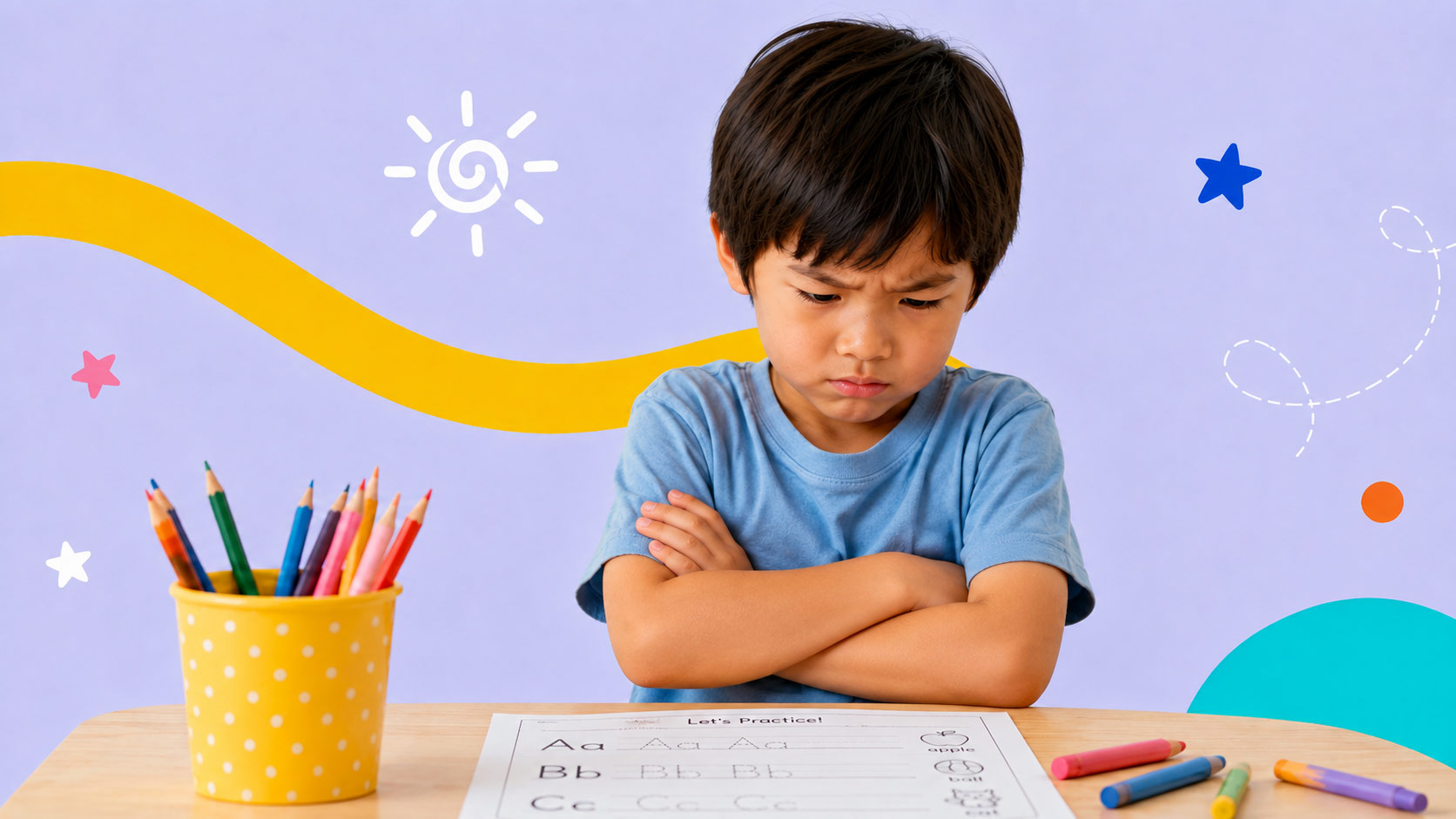
Nothing. That is the honest answer. A half-finished page is a normal outcome, not a sign that your child gives up on things, and the surest way to make it permanent is to ask them to go back and finish it.
I say this as someone who spent a long time doing the opposite.
The page is not the unit
The instinct to see it through comes from a reasonable place. We would like our children to learn that you finish what you start, and a page abandoned at the halfway mark looks like the exact opposite lesson.
But a coloring page is not a commitment. It is not homework, it has no deadline, and nobody is waiting on it. Treating it as something to be completed changes what it is, an activity a child chose becomes a task a child owes, and children notice that change immediately, even if they could not name it.
The thing worth protecting is not the page. It is whether they sit down at all tomorrow.
Leave it where it is
Do not tidy it away, and do not put it back in the book.
Leave the page out, open, with the pencils next to it. Say nothing about it. An abandoned page that is still lying there at four o’clock the next afternoon gets picked up surprisingly often, because picking it up requires no decision: no fetching, no asking, no announcement that they are Doing The Page Again.
Put it in a drawer and it is finished for good. Not because the child lost interest, but because restarting now costs something.
Why they stopped
Usually one of three things, and none of them is about willpower.
- They got tired. Coloring is more physical than it looks. Hand fatigue arrives long before boredom does, particularly in a four- or five-year-old still building grip strength.
- The page got harder. Large shapes first, small details later, and most children hit a section of fine work and quietly decide against it. That is a judgment about effort, and it is often a correct one.
- Something better appeared. A sibling, a noise outside, a thought. Attention in early childhood moves in waves rather than in a single block, which I wrote about in how long a five-year-old can actually concentrate.
None of those improve with encouragement. Two of them improve with a break.
What to say instead
If you want to say something, say something about the part they did rather than the part they did not.
Not “you’re nearly there,” which is a request wearing a compliment. Not “shall we finish it together?”, which is well meant, and it converts their thing into a joint project with an expectation attached.
Something closer to: you used a lot of orange on that one. Observational, requiring no response, carrying no plan. Then leave the room.
The version of this that actually matters
If half-finished pages are piling up faster than finished ones, the fix is almost never in the child. It is in the length of the sessions.
Ending on purpose while there is still interest left, before the wobble and not after it, leaves a page that feels paused rather than failed. I wrote about that in ten minutes of coloring, every day, which is really the same idea approached from the front.
A stack of pages abandoned in a good mood is a completely different object from a stack abandoned in a bad one.
Common questions
Should I make my child finish a coloring page?
No. A coloring page has no deadline and nobody is waiting on it. Requiring completion converts a chosen activity into an obligation, which makes a child less likely to sit down next time.
Why does my child never finish anything they start?
In early childhood this is usually hand fatigue, a jump in difficulty partway through a page, or attention naturally moving in waves, not a problem with persistence.
How do I get my child to come back to an unfinished page?
Leave it out, open, with the materials beside it, and say nothing. Removing the cost of restarting does more than any amount of encouragement.
Activity books made to be finished
Colouring pages, puzzles, fun facts, activities and creative challenges for kids!
Browse the books→Keep reading
Come along for the day-to-day.
Print a few pages and leave them out. If they keep getting picked up, our books work the same way.
Our activity books put all of this in one place. See the books →