
Ten minutes of coloring, every day

Ten minutes is enough. A short daily stretch of coloring works better than an occasional long session, because it removes the two things that usually ruin it: the pressure to produce something finished, and the expectation that your child will stay at the table for as long as you had hoped.
We started making activity books because of a specific frustration. Every book we bought was designed as an event: fifty pages of coloring that our daughter would attack with enormous enthusiasm on a Sunday and then never open again. The book was not the problem. The shape of it was.
Why short beats long
A long session has to earn its length. Somebody has to decide it is happening, clear the table, find the pencils, and then talk a child through the part where their arm gets tired and the page is only half done. By the end, everyone has an opinion about whether it went well.
Ten minutes asks nothing. It fits into the gap before dinner. Nobody has to commit, so nobody has to be talked into it, and nothing about it feels like a scheduled activity.
There is also the matter of what your child takes away. One long session teaches that coloring is a special occasion requiring preparation and a good mood. Ten minutes a day teaches that it is just something you can do, an option that exists in the house, like reading or going outside, available on ordinary Tuesdays when nobody is in a particularly creative frame of mind.
The second version is the one that lasts.
Stop before it stops itself
This is the part most of us get backwards, myself included, for a long time.
When a child is going well, the instinct is to protect it. Stay quiet, do not interrupt, let it run as long as it runs. And then it ends the way these things usually end: with a wobble, a scribble across the corner, a shove of the book, and a small person in a bad mood.
Ending on purpose while there is still interest left is better. Not as a rule enforced at the ten-minute mark, but as a judgment. You will feel the moment: the pace changes, the pencil starts pressing harder, they begin looking around the room. That is the moment to say the page can wait until tomorrow.
The next day, they come back to a page they left in a good mood. Over a few weeks that compounds into something quite different from a shelf of half-finished books.
If a page does get abandoned mid-wobble, that is fine too, and we wrote about what to do when a page gets abandoned separately.
Where the ten minutes actually fit
Not after school. Not straight after any transition, really. The stretch between arriving home and dinner is the worst-tempered part of the day in most houses, and asking a tired child to sit down and be creative in it is asking for a scene.
What works better, in our experience and in the experience of most parents we have talked to about it:
- The gap before dinner, once the initial noise of coming home has passed and the kitchen is busy anyway.
- Weekend mornings, which are the calmest attention most children have all week.
- The wind-down before bed, in place of a screen, particularly for children who find the transition to bedtime difficult.
- Waiting anywhere: the pediatrician, a restaurant, the twenty minutes before a sibling’s activity ends.
The last one is why we print our books at a size that fits in a bag.
Set it up so it costs nothing
The routine survives or dies on friction. If starting requires finding the book, then finding the pencils, then clearing space, it will not happen on a Tuesday.
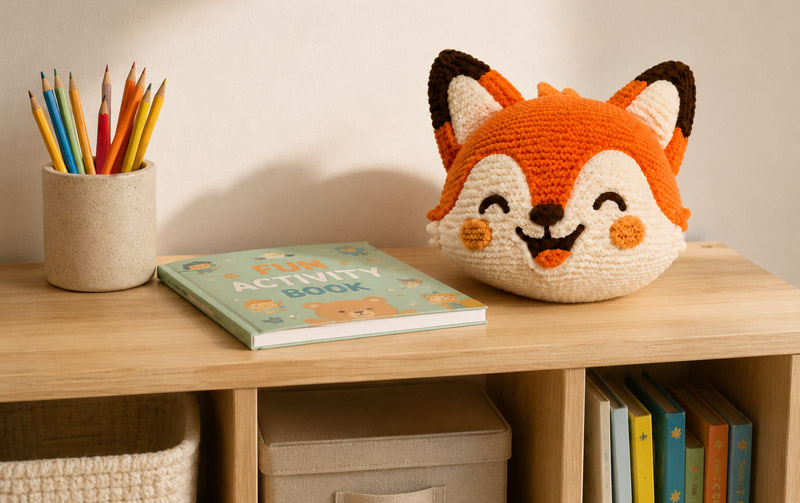
Keep the book and a small pot of colored pencils together, in the room where you actually are, at a height your child can reach without asking. Not in a cupboard. Not in the good box. Somewhere slightly untidy and entirely available.
And use dry materials: pencils, crayons, oil pastels. Our books are printed on standard book paper, so markers tend to bleed through to the illustration behind. If your child insists on markers, slide a spare sheet under the page they are working on.
What not to say
Two small things, and then this is done.
Do not ask what it is. A child mid-page is not usually making a representation of anything, and being asked to explain converts a quiet activity into a performance. If you want to say something, say what you notice: you used a lot of green there.
Do not suggest finishing. The page does not need to be finished. Nothing bad happens to an unfinished page. It sits there quietly, waiting, entirely unbothered.
Common questions
How long should a 5-year-old color for?
Ten minutes of unhurried coloring most days works better than one long session a week. Interest matters more than duration, and a child who chose the page will often stay longer than any guideline predicts.
Is coloring actually good for kids, or is it just a way to keep them quiet?
Both, honestly. Holding a pencil and staying inside a line builds hand strength and control, and a quiet activity that a child can do alone has obvious value on a difficult afternoon. Neither of those needs dressing up.
What if my child never finishes a page?
Nothing is lost. An unfinished page is a normal outcome, not a discipline problem, and pushing for completion is the fastest way to make the whole activity feel like work.
Activity books made to be finished
Colouring pages, puzzles, fun facts, activities and creative challenges for kids!
Browse the books→Keep reading
Come along for the day-to-day.
Print a few pages to start with. If the ten minutes stick, our books are built for exactly this.
Our activity books put all of this in one place. See the books →