20 Axolotl Facts for Kids (That Are Actually True)
Every fact below was checked against zoo, encyclopedia, and scientific sources, listed at the end.

These axolotl facts for kids are the ones worth repeating at the dinner table: short, surprising, and true. Axolotls have become a favorite on plushies, backpacks, and screens, and a lot of what gets said about the real animal online is a little off.
If you’re looking for fun facts about axolotls that hold up, each one below starts with a one-line version you can read aloud to younger kids. The paragraph under it is for older kids and curious grown-ups. Near the end, there’s a guide to the colors real axolotls come in, for anyone who wants to color one the way it looks in nature.
What is an axolotl? An axolotl (say ACK-suh-LAH-tuhl) is a salamander, a kind of amphibian, that spends its whole life underwater and keeps its feathery gills as an adult. In the wild, it lives only in the canals of Xochimilco, in Mexico City, where it is critically endangered.
What is an axolotl?
1. Axolotls are amphibians, not fish
Say it together!An axolotl is an amphibian, just like a frog.
Some people call it the “Mexican walking fish,” but an axolotl isn’t a fish. It belongs to the same animal group as frogs, toads, and newts. It also has four legs, which it uses to walk along the bottom of the water.
Color your own axolotl
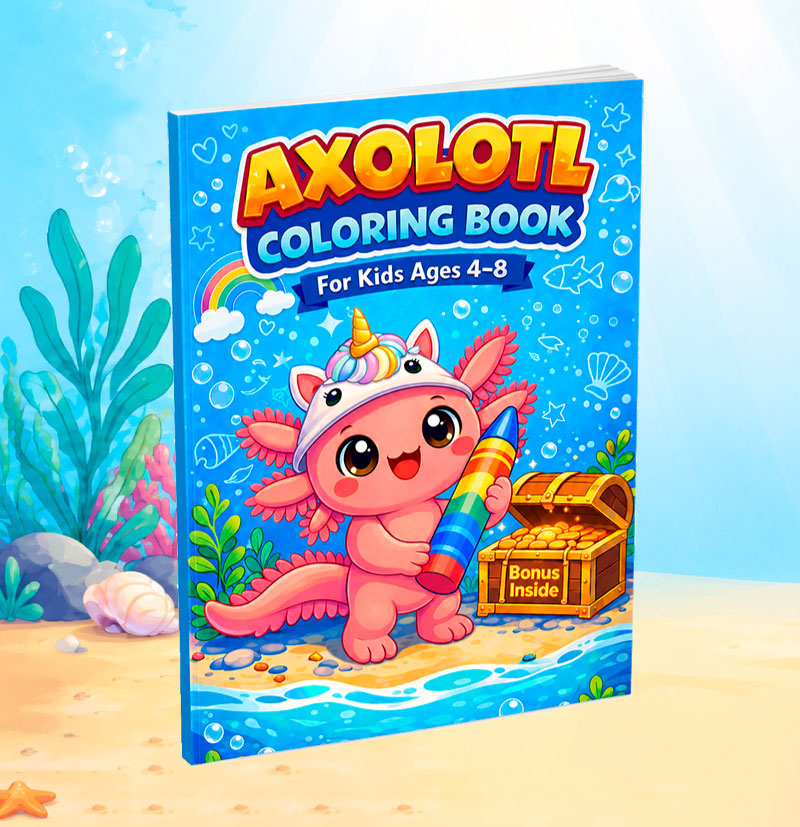
The Kiddalou Axolotl Coloring Book pairs 50 original axolotl illustrations with 50 facts like these, one on every page, and Lou the fox is hiding on 15 of them.
Want more axolotl fun? Get the free Axolotl Adventure Pack and print the activities at home.
2. They’re a kind of salamander
Say it together!Axolotls are salamanders, and tiger salamanders are their close cousins.
Scientists place axolotls in the mole salamander family, alongside the tiger salamander. The big difference between them shows up when they grow up.
3. Axolotls keep their baby features their whole lives
Say it together!Axolotls grow up, but they keep looking like babies.
Most salamanders start life in the water with gills and a fin along the tail, then lose both and move onto land. Axolotls skip that change. They become adults, and even have babies of their own, while keeping their gills, their tail fin, and their life underwater. Scientists call this neoteny.
4. Axolotls have no eyelids
Say it together!Axolotls can’t blink, because they don’t have eyelids.
Salamanders usually get moveable eyelids when they move onto land. Axolotls never make that move, so they never get them.
5. Very rarely, an axolotl can turn into a land salamander
Say it together!Once in a long while, an axolotl can lose its gills and live on land.
It almost never happens on its own. Scientists have caused the change in labs with thyroid hormone, but it’s hard on the animal and shortens its life. It’s work for scientists only, never something to try with a pet.
How do axolotls breathe?
6. Those feathery “horns” are gills
Say it together!The fluffy branches on an axolotl’s head are gills, for breathing underwater.
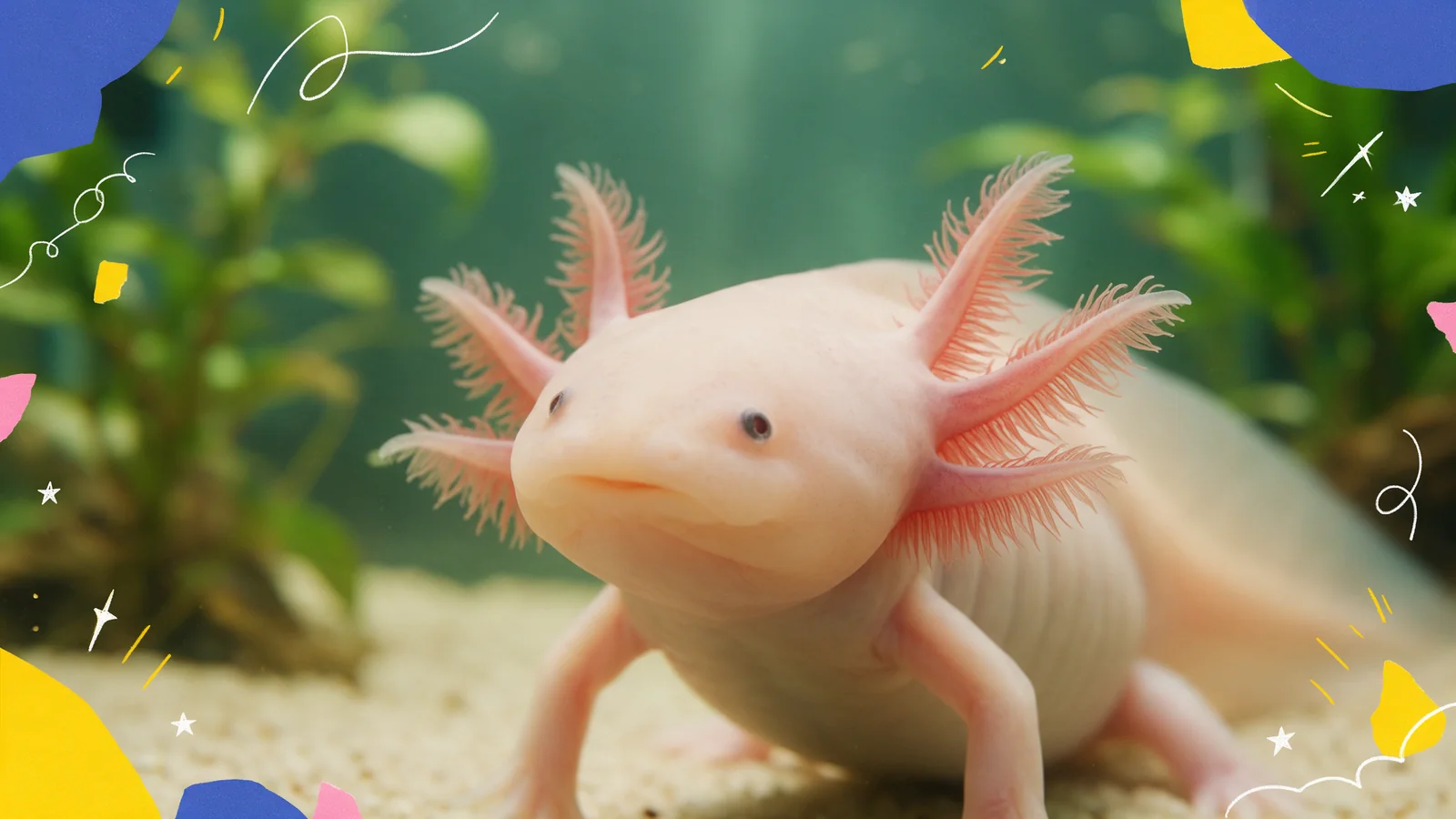
Do axolotls have gills? Yes, and they’re the first thing most people notice. There are normally three gill branches on each side of the head, each covered in thin filaments that take oxygen out of the water. An extra fourth branch on a side has occasionally been reported, but this is an unusual exception to the normal three-per-side arrangement. [Source]
7. Axolotls can breathe three ways
Say it together!Axolotls breathe with their gills, their skin, and little lungs.
Gills do most of the work. Some oxygen also passes through their thin skin. Adults have small lungs too, so every now and then an axolotl swims up to the surface to gulp a bit of air.
8. Pale axolotls have pink gills because of their blood
Say it together!In pale axolotls, the red you see in the gills is blood.
Light-colored axolotls have little dark pigment, so the blood flowing through their gills shows through as pink or red. Axolotls with natural wild coloring have darker gills.
The axolotl superpower: regrowing body parts
9. An axolotl can regrow a whole leg
Say it together!If an axolotl loses a leg, it can grow a brand-new one.
The new leg grows back complete, with bone, muscle, nerves, skin, and toes, and without a scar. Depending on the conditions, it takes several weeks to a few months.
10. They can repair parts of their heart, brain, and spinal cord
Say it together!Axolotls can even fix parts of their heart and their brain.
Axolotls can regrow parts of their spinal cord, heart, and brain, and parts of their eyes as well. That’s parts, not the whole brain, whatever you might read elsewhere.
11. Scientists have studied axolotls for more than 150 years
Say it together!Scientists have been learning from axolotls for more than 150 years.
Labs around the world keep axolotls to understand how they heal without scars. Researchers hope it could one day help doctors treat people with serious injuries, but that’s still a hope, not a treatment.
12. An axolotl’s DNA is about 10 times longer than yours
Say it together!An axolotl’s instruction book, its DNA, is about ten times longer than a person’s.
When scientists published the axolotl genome in 2018, it was the largest genome ever sequenced: about 32 billion letters of genetic code, compared with roughly 3 billion in humans. Even bigger genomes have been found since.
Where do axolotls live?
13. In the wild, axolotls live in only one place
Say it together!Wild axolotls live in just one place on Earth: Xochimilco, in Mexico City.
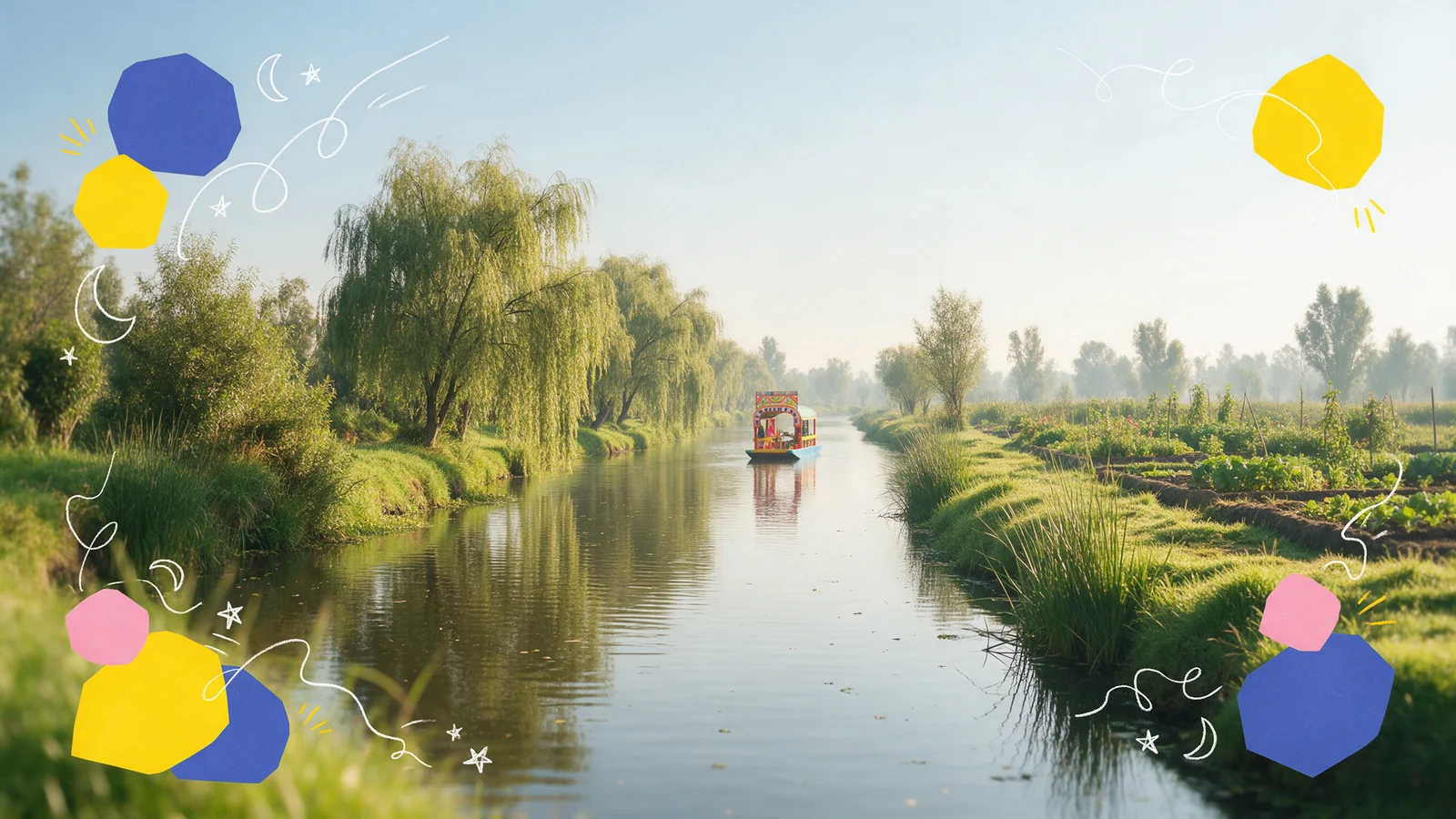
Long ago they lived in two lakes in the Valley of Mexico, Xochimilco and Chalco. Lake Chalco was drained, and Xochimilco (say so-chee-MEEL-ko) survives mostly as a network of canals on the southern edge of Mexico City. Those canals are the axolotl’s last wild home.
14. Wild axolotls are critically endangered
Say it together!There are very few axolotls left in the wild.
The IUCN Red List classes the axolotl as critically endangered, the last category before extinct in the wild. Estimates put the wild population somewhere between 50 and 1,000 adults. Polluted water, a growing city, and fish such as carp and tilapia that were brought into the canals, eat axolotl eggs and young, and compete for their food, are the main reasons.
15. Most axolotls alive today live in tanks
Say it together!Most axolotls today live in aquariums, labs, and homes.
Many thousands are kept in research labs, zoos, and homes, all bred in captivity. That’s why it’s easy to see an axolotl at an aquarium and so hard to find one in the wild.
What do axolotls eat, and how big do they get?
16. Axolotls are hunters that slurp up their food
Say it together!Axolotls eat worms, bugs, and tiny fish, and they suck them right in.
Axolotls are carnivores. In the wild they eat worms, insect larvae, small crustaceans, snails, and small fish, and they mostly hunt at night. When they strike, they open their mouth fast, water rushes in, and the food goes in with it.
17. Most adult axolotls are about 9 inches long
Say it together!A grown-up axolotl is about as long as three-quarters of a school ruler.
That’s about 9 inches, or 23 cm, though a few reach 12 inches. In aquariums, axolotls can live up to 15 years.
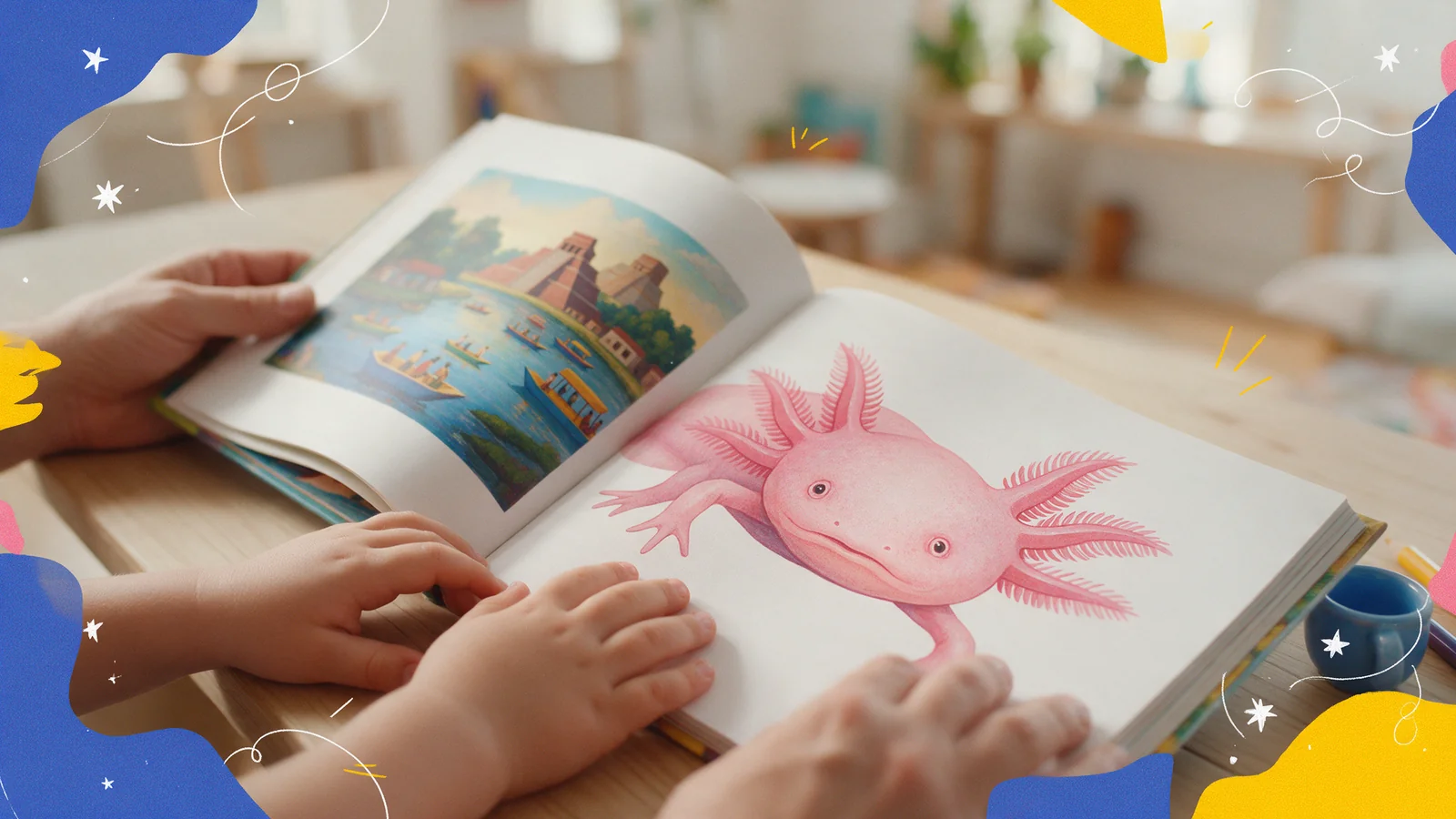
What does axolotl mean?
18. Their name comes from the Aztec language
Say it together!“Axolotl” is a word from Nahuatl, the language of the Aztecs.
Atl means water. Xolotl was the name of an Aztec god, often shown with the head of a dog, and the word could also mean twin or servant. That’s why the meaning of axolotl gets translated as “water dog,” “water twin,” or “water monster,” depending on who you ask. In English, most people say ACK-suh-LAH-tuhl.
19. There’s an axolotl on Mexico’s 50-peso bill
Say it together!In Mexico, there’s an axolotl on the money.
Since 2021, the back of Mexico’s 50-peso note has shown an axolotl in the canals of Xochimilco, next to corn plants.
What color are axolotls?
20. Wild axolotls aren’t pink
Say it together!Wild axolotls are dark brown and green, with gold speckles.
The pink and white axolotls you see in pet shops and cartoons were bred by people. In nature, axolotls are brown, tan, or olive, with gold flecks and darker spots. Those muddy colors help them hide at the bottom of the canals.
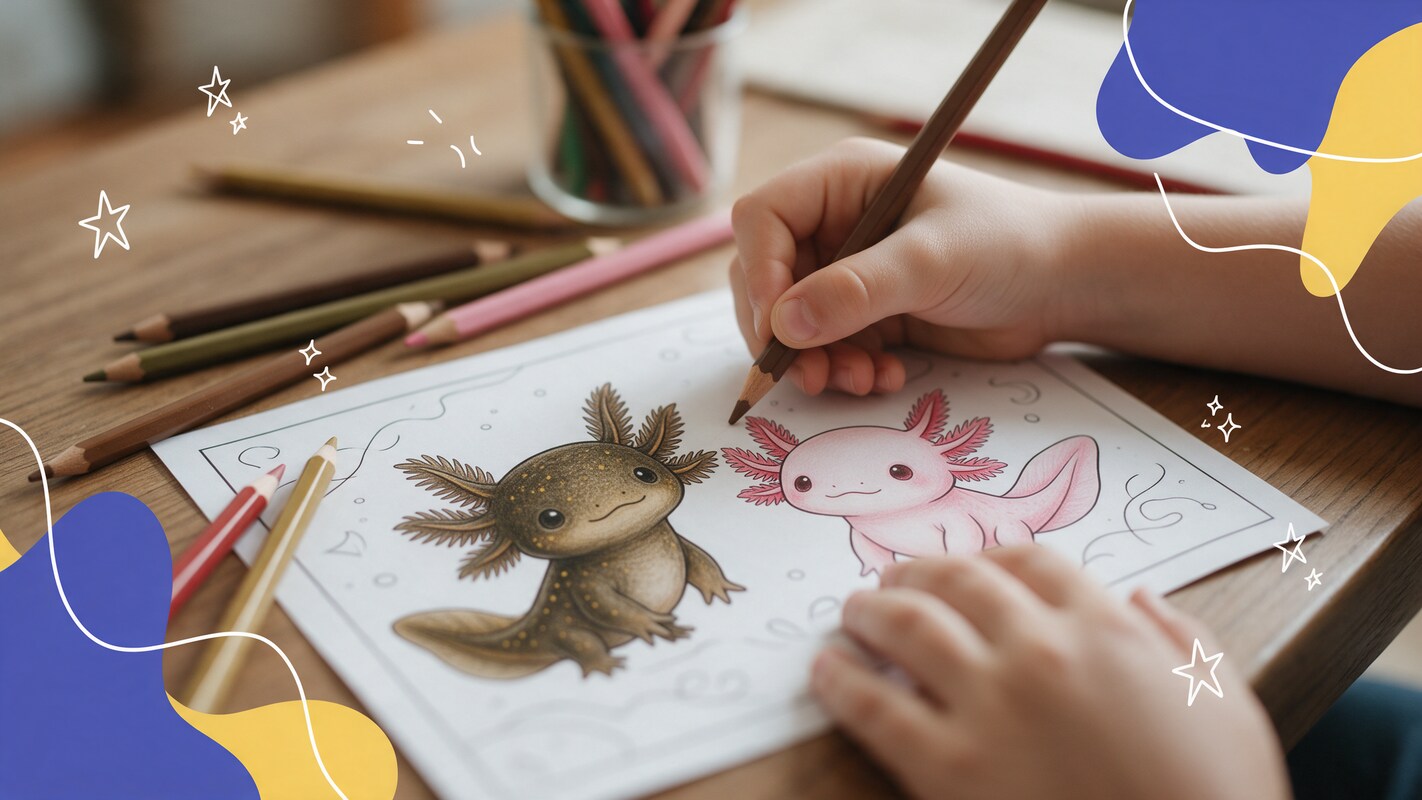
Color an axolotl the way it really looks
There’s no wrong color for an axolotl on paper. But when a child asks what a real one looks like, these are the color types you’ll find, from the wild one to the colors bred in captivity.
| Color type | What it looks like | Colors to reach for |
|---|---|---|
| Wild type | Brown, tan, or olive green, with gold speckles and dark spots | Brown, olive green, and gold or yellow for the speckles |
| Leucistic (“lucy”) | White to pale pink, with dark eyes and pink-red gills | Pale pink, red-pink for the gills, black for the eyes |
| White albino | White, with pink-red eyes | White or very pale pink, red for the eyes |
| Golden albino | Yellow-gold all over, with light eyes | Yellow, gold, and peach |
| Melanoid | Very dark, almost black, with little shine | Dark gray, black, and deep green |
Axolotl myths you’ll read online
“Axolotls turn their gills into lungs as they grow up.”
They don’t. Axolotls keep their gills for life. Their small lungs develop alongside the gills.
“An axolotl is a fish.”
It’s an amphibian, a kind of salamander. “Mexican walking fish” is only a nickname.
“Axolotls live in lakes all over Mexico.”
Wild axolotls survive only in the canals of Xochimilco, in Mexico City.
“Axolotls can regrow their whole brain.”
They can regrow parts of the brain, which is remarkable enough.
“Wild axolotls are pink.”
Wild axolotls are dark brown or olive with gold speckles. Pink ones come from captive breeding.
How to share these facts with kids
The most interesting facts about axolotls are the ones a child can picture, so pick one at a time instead of reading all twenty.
- Ages 4 to 6: read only the “Say it together!” line, then wait for their questions.
- Ages 7 and up: read the whole fact, then ask a question back.
Color your own axolotl
The Kiddalou Axolotl Coloring Book pairs 50 original axolotl illustrations with 50 facts like these, one on every page, and Lou the fox is hiding on 15 of them.
Want more axolotl fun? Get the free Axolotl Adventure Pack and print the activities at home.
Sources
- San Diego Zoo Wildlife Alliance. Axolotl (Ambystoma mexicanum) Fact Sheet. Classification, habitat, IUCN status, and wild population estimate.
- Encyclopaedia Britannica. Axolotl. Neoteny, wild coloring, size, and lifespan in captivity.
- Marine Biological Laboratory. Axolotl research organism. Regeneration, genome, size, and diet.
- Marine Biological Laboratory. The axolotl can regrow a lost leg, a piece of its heart, parts of its spinal cord, and sections of its brain. Leg regrowth timing and retina repair.
- PBS Nature. Axolotl Fact Sheet. Gills, lungs, and the lack of moveable eyelids.
- Akron Zoo. About Axolotls. Breathing through gills, skin, and lungs.
- Point Defiance Zoo & Aquarium. Axolotl care article. Three gill branches on each side of the head.
- Nowoshilow, S., et al. “The axolotl genome and the evolution of key tissue formation regulators.” Nature, 2018. doi:10.1038/nature25458.
- Scientific American. The population of a unique Mexican amphibian drops 90 percent in four years. Introduced carp and tilapia.
- American Heritage Dictionary. axolotl. Nahuatl origin of the name.
- Museo Banco de México. Axolotl activity sheet (in Spanish). The 50-peso note.
- PetMD. Axolotl Colors. Wild coloring, camouflage, and captive color types.
Keep reading



Come along for the day-to-day.
Free pages for the independent block. Our books hold a theme together for longer.
Our activity books put all of this in one place. See the books →