
What coloring, cutting, and tracing actually build
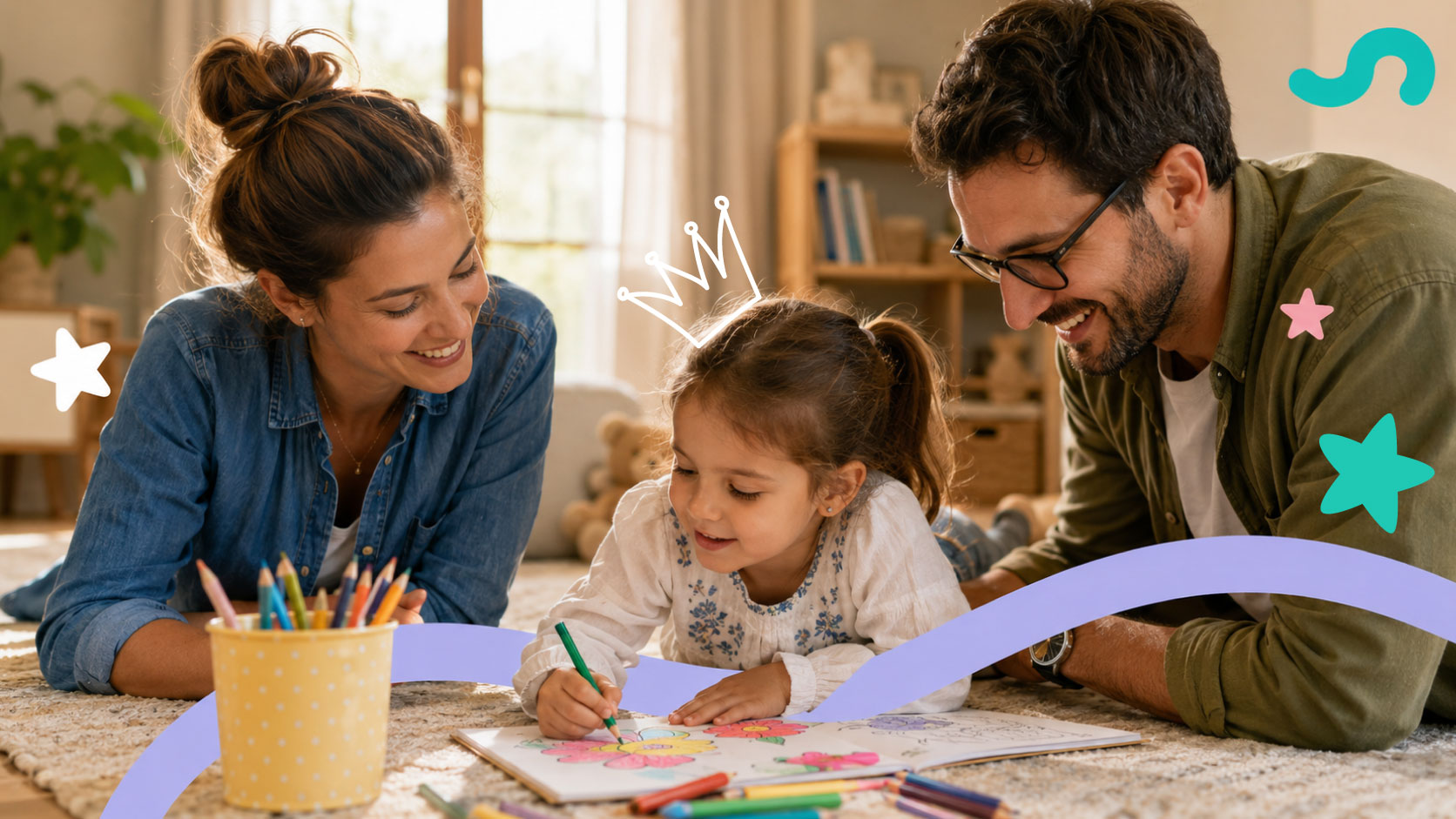
Fine motor skills measured around the start of school predict later reading and math achievement. That finding is real, replicated, and easy to misread. It does not mean that coloring makes children better at math, and the reason why is more interesting than the headline.
What the research found
In 2010, a team led by David Grissmer at the University of Virginia went looking for the things that predict how a child does years later. They analyzed several long-term data sets and found that fine motor skills at kindergarten entry were a strong predictor of later achievement, alongside attention and general knowledge about the world, and adding predictive power beyond early reading and math scores alone.
It has held up since. A 2012 study of kindergarteners found that fine motor skills and executive function each contributed independently to achievement across multiple standardized subtests. Research since has repeated the pattern in different countries and age groups.
So the association is not in doubt. What the association means is where most articles stop reading.
The part that isn’t about hands
Fine motor skill is not one thing. Researchers separate it into at least two components, and they behave very differently.
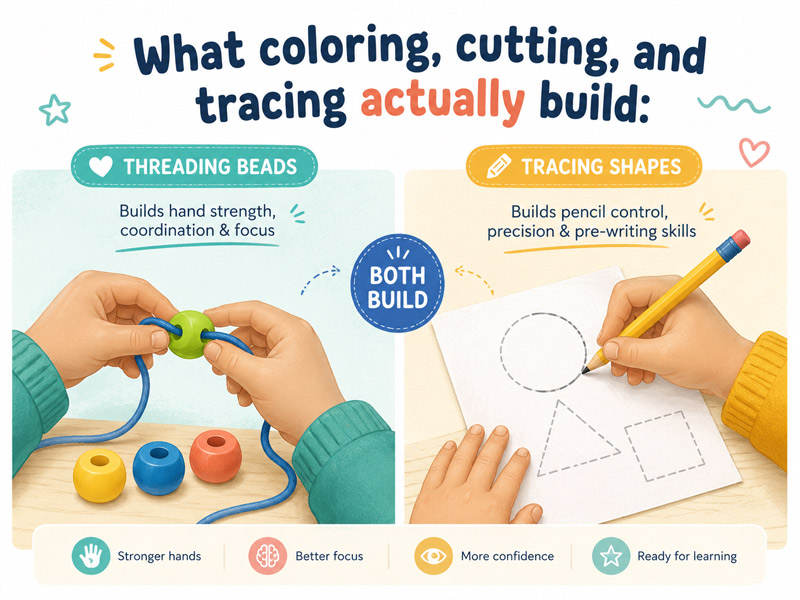
Fine motor precision is dexterity in the narrow sense: threading, placing, manipulating small objects accurately.
Fine motor integration is copying a shape you can see. Look at a design, understand its structure, reproduce it on paper.
It is consistently integration that does the predictive work. A 2016 study of primary school children in the UK found the two components related differently to early reading and math, with integration carrying more weight. The 2012 kindergarten study found the same: it was design copy specifically that predicted achievement.
Copying a shape is barely a motor task. You have to perceive the shape, hold it in working memory, break it into parts, plan a sequence, and execute, all while monitoring whether what is appearing matches what you intended. That is attention, visual processing, planning, and self-correction, with a pencil attached.
Which suggests the honest interpretation: fine motor tasks are not building the skills that matter so much as revealing them. The hand is a window, not an engine.
So does coloring do anything?
Yes, but be specific about what.
- Endurance. Holding a pencil and applying steady pressure is physically demanding for a four- or five-year-old. Hand fatigue is why most pages get abandoned, and it improves only with use.
- Control at a small scale. Staying roughly inside a line is a genuine skill, and it transfers directly to letter formation later.
- Sustained attention on a self-directed task. A page has no teacher pacing it. The child decides when to start, where to go next, and when it is done, and that self-direction is closer to what the research is measuring than the finger movements are.
- Tolerance for effort. A page that takes twenty minutes and looks better at the end than it did in the middle teaches something that is hard to teach directly.
What it does not do is make a child better at math in any direct way. Nobody has shown that, and the studies are correlational, so they cannot rule out that some third factor, such as how much a household reads and draws together, drives both.
Cutting is underrated
If you only added one activity, add scissors.
Cutting along a line uses both hands doing different jobs at the same time, one holding and turning the paper, one opening and closing the blades, while the eyes track a target ahead of the cut. Very few activities ask for that combination.
It is also the one most likely to be skipped, because scissors make a mess and require supervision. Worth the mess. Start with straight lines on thick paper, move to curves, then to shapes with corners, which are the hard part.
What not to turn it into
Do not correct the grip. More on that in handwriting practice that doesn’t feel like homework, but the short version is that the evidence does not support intervening on grip in a typically developing child.
Do not add instruction. These activities work because a child does them alone. Turning coloring into a lesson about staying inside the lines converts it into an assessment, and children can tell.
Do not chase the finished page. Twenty focused minutes on half a page is worth more than a rushed complete one. If pages keep getting abandoned, that is usually about session length rather than persistence.
Do not treat this as academic preparation. The moment it becomes preparation for something, the self-direction that made it valuable is gone.
And if your week already runs on printed pages, the question worth asking is which of them are earning their place: using printables without creating busywork.
The reasonable version
Fine motor activities are worth doing. They build real, specific things, they are pleasant, and they cost almost nothing. That is a sufficient case on its own.
The research is a reason to take them seriously, not a promise about outcomes. If your five-year-old spends twenty minutes cutting shapes out of paper this afternoon, something useful is happening. It is just not the thing the headline said.
Common questions
Do fine motor skills affect academic performance?
Fine motor skills at school entry are a well-replicated predictor of later reading and math. The relationship is correlational, and the strongest predictor is design copy, a task that draws on perception, planning, and attention as much as on hand control.
What activities build fine motor skills in preschoolers?
Coloring, tracing, cutting with scissors, threading, and drawing all work. Cutting is the most demanding of the group, because it requires both hands doing different tasks while the eyes track ahead.
Does coloring help kids do better in school?
Not directly, and nobody has demonstrated that it does. Coloring builds hand endurance, small-scale control, and sustained attention on a self-directed task, all worth having in their own right.
Activity books made to be finished
Colouring pages, puzzles, fun facts, activities and creative challenges for kids!
Browse the books→Sources
- Grissmer, D., Grimm, K. J., Aiyer, S. M., Murrah, W. M., & Steele, J. S. “Fine Motor Skills and Early Comprehension of the World: Two New School Readiness Indicators.” Developmental Psychology, 46, no. 5 (2010): 1008–1017.
- Cameron, C. E., Brock, L. L., Murrah, W. M., Bell, L. H., Worzalla, S. L., Grissmer, D., & Morrison, F. J. “Fine Motor Skills and Executive Function Both Contribute to Kindergarten Achievement.” Child Development, 83, no. 4 (2012): 1229–1244.
- Pitchford, N. J., Papini, C., Outhwaite, L. A., & Gulliford, A. “Fine Motor Skills Predict Maths Ability Better than They Predict Reading Ability in the Early Primary School Years.” Frontiers in Psychology, 7 (2016): 783.
Keep reading

Come along for the day-to-day.
Tracing, cutting, and coloring pages, free to print. Our books put them in one place.
Our activity books put all of this in one place. See the books →