
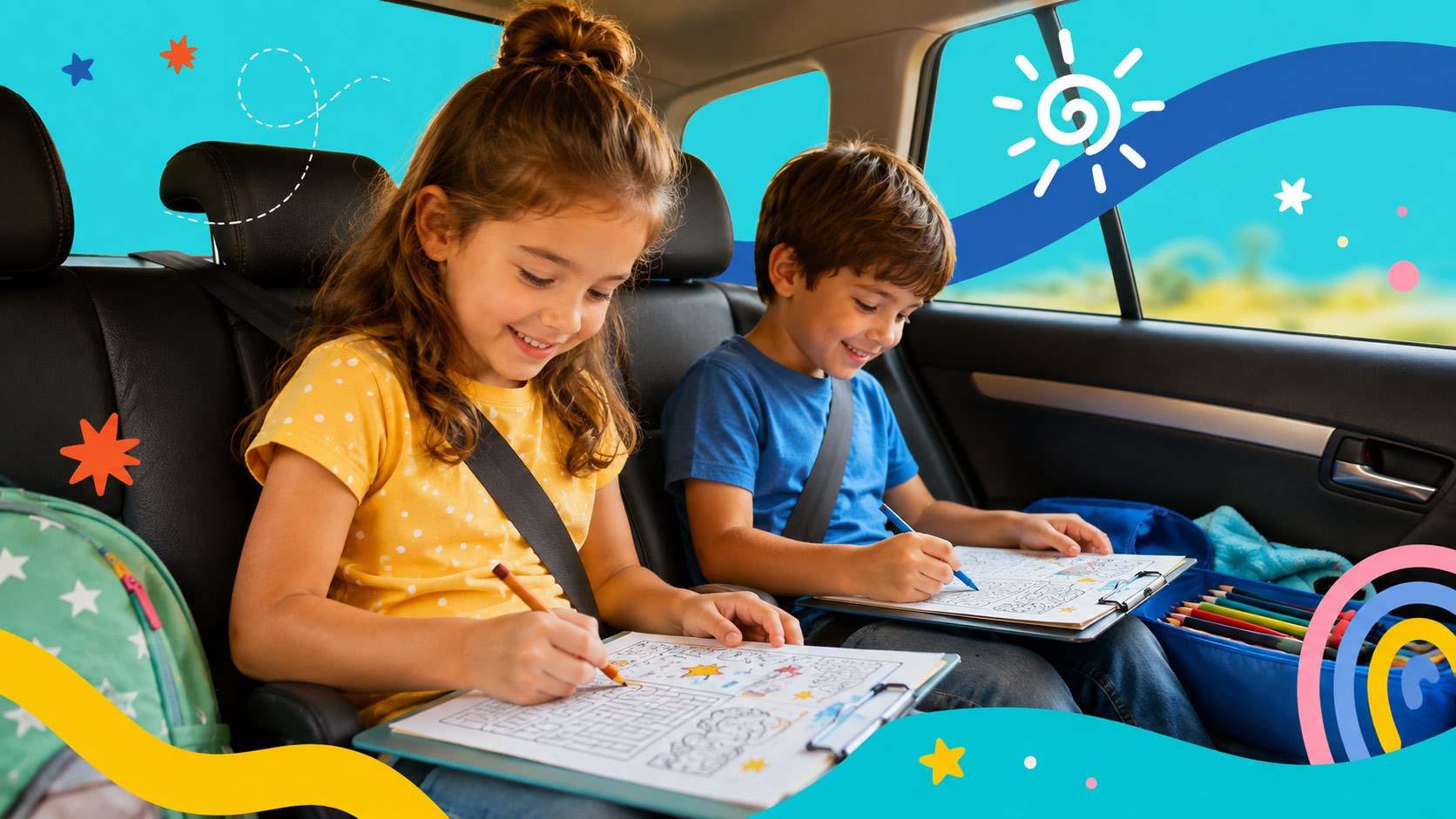
Six pages, one folder, one clipboard. That is the whole kit. It weighs almost nothing, it costs whatever your printer costs, and it covers roughly two hours of a car journey, which is usually the difference between arriving in a reasonable mood and arriving in the other kind.
This is the version we have landed on after several trips of packing too much. The mistake is always the same: bringing a whole activity book, which becomes a whole activity book on the floor of the footwell by the second hour.
What goes in
Six pages, chosen so that no two ask for the same kind of concentration:
- A coloring page. Big shapes, not fine detail. Detailed line work does not survive a moving car, and a child who cannot stay inside the line because of a pothole gets frustrated fast.
- A maze. Short. One page, solvable in a few minutes, ideally with a route that doubles back so it is not obvious from above.
- A word search. For readers. This is the page that reliably eats the most time per sheet.
- A spot-the-difference. Works for a wider age range than almost anything else, and works in poor light.
- A blank page. Genuinely blank. This gets used more than any of the others, usually for something you did not anticipate.
- One wildcard. Whatever your particular child is currently interested in: a dot-to-dot, a kids’ sudoku, a page of writing practice, a drawing prompt.
That is it. Six is enough for two hours and few enough to fit in one folder without bending.
The order matters more than the contents
Do not hand over the folder.
If your child gets all six pages at the start, they will fan through them, pick the best one, do half of it, and then own a pile of paper they have already dismissed. The kit is spent in fifteen minutes.
Hand over one page at a time, and hold the rest. Not as a bargaining chip, just as a way of keeping each page new when it arrives. The wildcard goes last, held for the stretch where things start to unravel, which on most journeys is somewhere around the ninety-minute mark.
The things that make it work
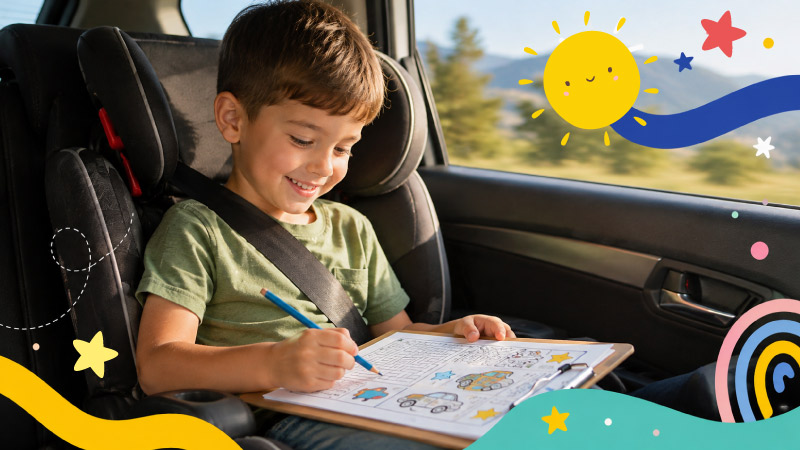
A clipboard. This is the single item that turns a bag of paper into a functional setup. Loose sheets slide off laps at every corner. A cheap clipboard, one per child, solves it permanently. A hardback book underneath works if you do not have one.
Colored pencils in a flat case, not a pot. Pots tip. Anything that rolls under a seat is gone for the rest of the journey and will be mentioned repeatedly.
A folder for the finished pages. Two folders, really: one for the pages to come and one for the pages that are done. Finished work that disappears into a footwell feels like it did not count.
Pencils, not markers. Dry materials only in a car. This is partly about bleed-through and mostly about upholstery.
What to leave out
- Anything with small pieces. Stickers, cut-outs, anything requiring scissors. All of it ends up under a seat, and none of it can be retrieved at seventy miles an hour.
- Anything timed or competitive. Two children in a confined space plus a race is a known formula.
- A whole book. Tempting, and wrong. A book invites flicking rather than doing, and it is heavy enough that nobody wants to hold it.
- Anything that needs you. If a page requires a parent to explain the instructions, it will be attempted at the exact moment you are merging onto a highway. Every page in the kit should be self-explanatory from a glance at it.
For different ages
4 to 6. Four pages rather than six. Big-shape coloring, a simple maze, a spot-the-difference, and the blank page. Attention in the car is shorter than at home, and that is normal.
7 to 9. The full six. This is the age the kit was designed for, and word searches start earning their place around here.
10 to 12. Swap the coloring page for something with more resistance: a harder sudoku, a crossword, a drawing challenge with a constraint. Older children will use the blank page most of all.
Print it the night before
The kit fails on preparation, not design. Printing six pages takes four minutes and nobody ever does it before the morning of the trip, which is how it ends up not happening.
Print it the night before. Put it in the bag the night before. The folder does not care how long it waits.
For the pages themselves, our free printable activities include everything on the list: coloring pages, mazes, word searches, spot the difference, sudoku, and writing practice, in US Letter and A4, at full size with nothing cut off.
If your journey involves an airport rather than a car, the constraints are different enough that we wrote screen-free plane activities separately.
Common questions
What should I put in a car activity kit for kids?
Six printed pages that each ask for a different kind of attention: a simple coloring page, a maze, a word search, a spot-the-difference, a blank sheet, and one wildcard chosen for your child, plus a clipboard and colored pencils in a flat case.
How do I keep kids busy in the car without screens?
Hand out one page at a time rather than the whole set, keep every activity self-explanatory so it needs no adult input, and hold one page back for the last stretch of the journey.
What age is a printable car kit good for?
Roughly 4 to 12, with the contents adjusted: fewer, simpler pages for younger children and more demanding puzzles for older ones. The blank page works at every age.
Activity books made to be finished
Colouring pages, puzzles, fun facts, activities and creative challenges for kids!
Browse the books→Keep reading


Come along for the day-to-day.
Print the six pages here. Our books are sized to fit in the same bag.
Our activity books put all of this in one place. See the books →