
Using printables in your homeschool without creating busywork
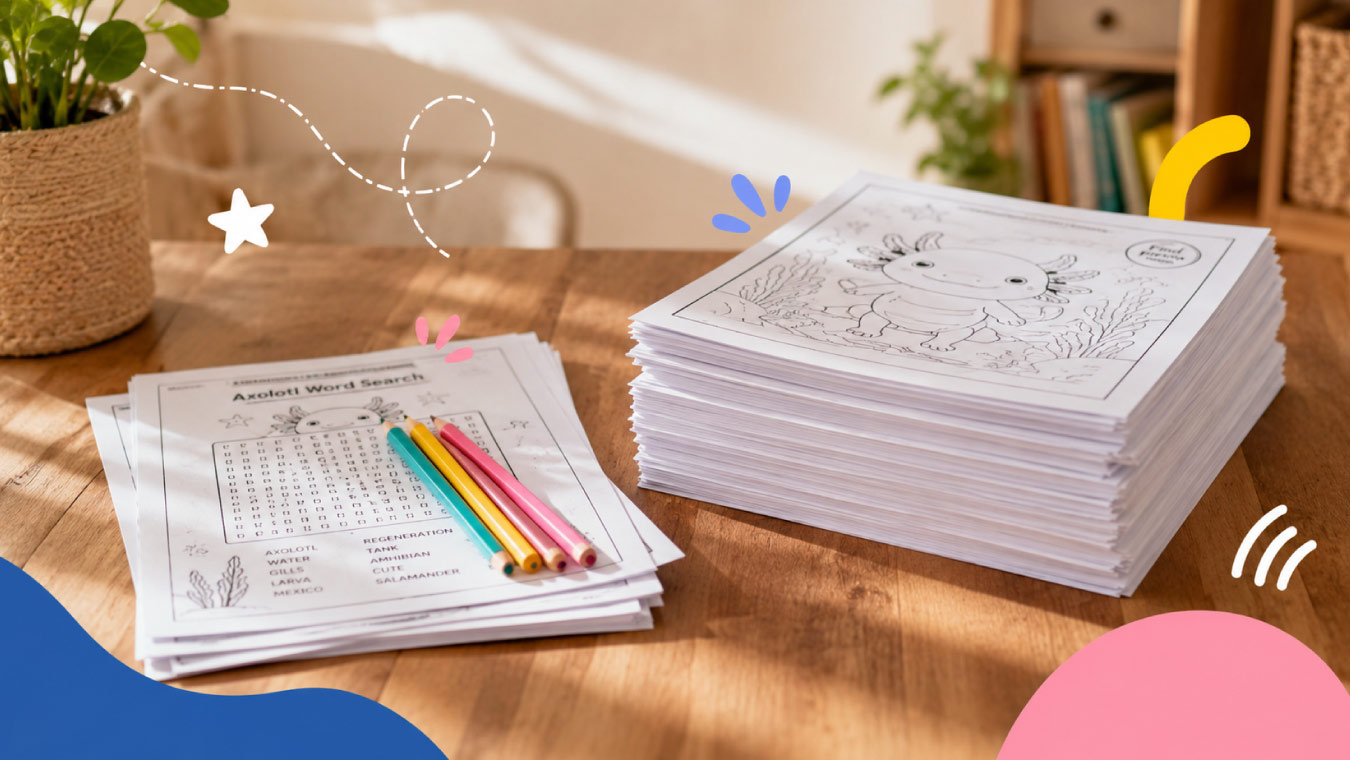
A printable is worth printing if it does something a conversation could not. That is the whole test. Practice a skill that needs repetition, occupy a child productively while you teach a sibling, give something to hold on to at the end of a topic. Those are jobs. Filling twenty minutes because the morning had twenty minutes left in it is not.
We make free printables, so treat what follows accordingly. It is still the honest advice: most homeschools print too much, and the ones that print less get more out of it.
Why printables get overused
Three reasons, and they are all understandable.
They are visible. A finished sheet is evidence. Twenty minutes of conversation about why volcanoes erupt leaves nothing on the table, and a parent who has spent a year teaching at home without much external validation can start to feel uneasy about that.
They are free and infinite. There is no shortage, no cost, and no friction. Anything with those three properties gets overused.
They fill gaps reliably. A worksheet is the fastest way to convert an awkward half hour into an occupied one, and gaps happen constantly in a home day.
None of these are bad reasons. They are just not reasons about learning.
Three questions before you print
What is this replacing? If the answer is “nothing, we had time,” stop. If it is “the fourth time I explain this out loud,” print it.
Could my child do this alone? A printable that needs an adult sitting beside it is not doing the one thing printables do best. Save your attention for teaching and let the sheet handle the independent block.
What happens to it afterward? If it goes straight into recycling, that is fine for practice. If it is going into a portfolio as evidence of a year’s work, ask whether it is the strongest thing you have. It usually is not.
Four jobs a printable does well
Repetition that has to happen. Letter formation, number facts, spelling patterns. Skills that improve with reps and get worse with lectures. Short and frequent beats long and occasional, the same principle as ten minutes of coloring, every day.
The independent block. The single most useful thing a printable does in a multi-child homeschool. One child works alone for fifteen minutes while you teach the other. It has to be genuinely self-explanatory or it fails at the exact moment you need it to work.
Retrieval, not just practice. A sheet done a week after a topic finishes is far more useful than one done the same afternoon. Same worksheet, different job. Pulling something back out of memory is where the learning happens; copying it while it is still on the table is not.
Transitions. The gap between finishing math and starting anything else is where a morning derails. A short, low-stakes page gets everyone across it.
Four things to stop printing
Anything printed the night before to fill a slot. If you cannot name what it is for, it is filler and your child will know within a minute.
Coloring pages as academic work. Coloring is genuinely worth doing. It builds hand endurance and control, which does real work over time. It is not math practice, and logging it as such will not fool anyone, least of all you in April.
Long sheets. A page with forty problems teaches that the goal is to reach the end. Ten problems done carefully is better practice and a shorter argument.
The second sheet on the same skill in the same sitting. If the first one went well, they have it. If it went badly, another one will not fix it and will damage how they feel about the skill.
The portfolio question
In states that require work samples, there is a temptation to print heavily so there is something to show.
Resist it. A portfolio built from twenty worksheets and a portfolio built from three real pieces of work, such as a story they wrote, a diagram they made, or a project they chose, do not read the same to anyone assessing them, and only one of them is a pleasant afternoon to assemble in the spring.
Requirements vary enormously by state, and some states ask for nothing at all. Check your own state’s department of education rather than copying what another family does, and remember that instruction is generally what counts, not paper.
Building a small, reusable set
You need far fewer than you think. A workable set for one child:
- One sheet for whatever skill is currently being drilled
- One puzzle-type page for the independent block: a maze, a word search, a sudoku
- One open page for retrieval, used a week behind the teaching
- One coloring page for transitions and for the end of a hard morning
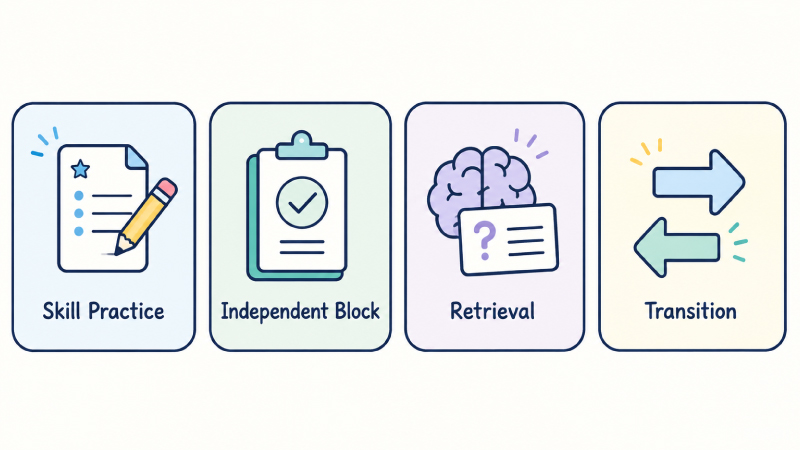
Four categories, printed as needed. Not a folder of eighty pages downloaded in a burst of enthusiasm in August, which is what most of us end up with.
Our free printable activities cover all four: coloring pages, mazes, word searches, kids’ sudoku, spot the difference, and writing practice, all in US Letter and A4, printed at full size with nothing cut off.
And if the day feels too long before you even reach the printables, the problem may be upstream: a homeschool day needs far less clock time than a school day.
Common questions
Are printables good for homeschooling?
Yes, for specific jobs: repetition that needs volume, independent work while you teach another child, retrieval a week after a topic, and transitions between subjects. They stop being useful when they are printed to fill time.
How many worksheets should a homeschooler do a day?
Fewer than most families print. One purposeful sheet per skill being practiced is usually enough. A second sheet on the same skill in the same sitting adds fatigue rather than learning.
Do worksheets count as homeschool records?
Requirements vary by state, and some states ask for no records at all. Where work samples are required, a small number of substantial pieces generally represents a year better than a large stack of worksheets. Check your state’s department of education for what is actually asked.
Activity books made to be finished
Colouring pages, puzzles, fun facts, activities and creative challenges for kids!
Browse the books→Keep reading



Come along for the day-to-day.
Print what you need, when you need it. Our books do the same job with a theme running through it.
Our activity books put all of this in one place. See the books →