
What to do when your kid says “I’m bored”

Wait. Not indefinitely, and not as a principle. Just longer than feels comfortable. Most boredom resolves itself within ten or fifteen minutes if nobody intervenes, and the intervening is what teaches a child that boredom is somebody else’s job to fix.
That is the whole answer. What follows is the practical version, for the afternoons when waiting is not working.
The waiting part
“I’m bored” is rarely a request for a specific activity. It is closer to a status update, delivered in the hope that somebody does something about it.
The useful response is acknowledgment without a solution. Yeah, that happens. Then carry on with whatever you were doing.
This feels dismissive the first few times. It is not, provided the acknowledgment is genuine. The child is not being ignored, they are being told that this is a normal state that does not require an emergency response. Most children, faced with an adult who is clearly not going to produce an activity, go and find one.
Give it fifteen minutes before doing anything else. Boredom is uncomfortable, not harmful, and the discomfort is what produces the next idea.
Four things that reliably help
When fifteen minutes have passed and the drifting has not converted into anything, these work better than a list of suggestions.
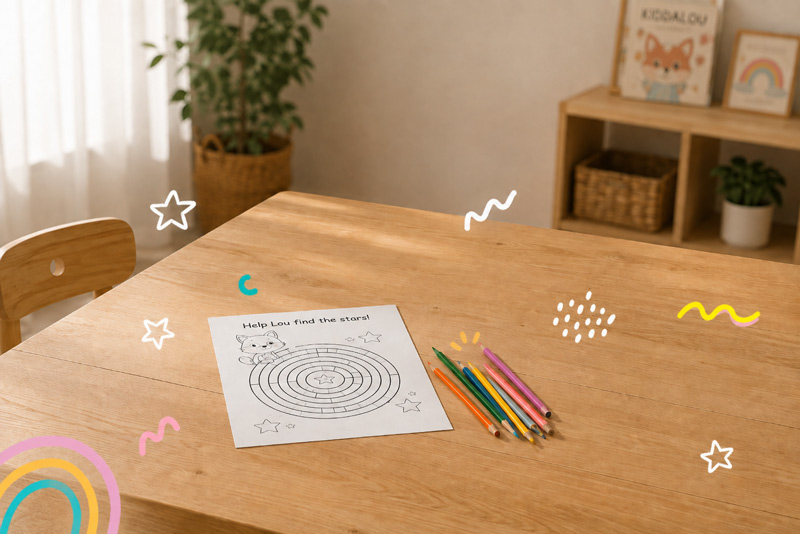
Put something out without offering it. A page, a puzzle book, a box of something, left on the table with no comment. An offer can be refused; an object on a table cannot. This is by some distance the highest-yield move on the list.
Give a job, not an activity. Something real that needs doing: washing something, sorting something, carrying something. Real tasks hold attention better than invented ones because a child can tell the difference, and the end point is obvious.
Change the room. Not the activity, the location. A child who has run out of ideas in the living room frequently has ideas in the kitchen, or on the stairs, or outside for four minutes.
Ask what they were doing yesterday. Not what they want to do, because that question almost always gets “I don’t know,” because choosing is the hard part. Pointing at something that already worked skips the choosing.
What to stop offering
A list of options. Every rejected suggestion makes the next one weaker, and a run of five rejections ends with an adult who is annoyed and a child who is still bored. If you have offered two things and both were refused, stop offering.
A screen. It works, which is the problem. It removes the boredom instantly and removes the thing boredom was about to produce. It also raises the bar for everything else in the house for the rest of the afternoon. An available screen makes ordinary activities feel duller by comparison, which is covered in a realistic screen-free afternoon.
Yourself. Playing with your child is good and worth doing on purpose. Playing with your child because they announced boredom teaches that the announcement summons a parent, and it will be repeated.
Why boredom is worth keeping
The gap between “nothing to do” and the next thing is where the next thing comes from. A child who is never bored is a child whose time is fully programmed, and programmed time does not generate ideas, it consumes them.
This is not an argument for leaving a child adrift all afternoon. It is an argument for tolerating fifteen minutes of complaint before reaching for a solution, on the grounds that something usually happens in minute sixteen.
What it looks like when it works
Not dramatic. There is no moment of inspiration.
A child drifts, announces boredom twice, gets no useful response, lies on the floor, gets up, wanders into another room, and forty minutes later there is an elaborate arrangement of cushions with rules attached to it that nobody asked for.
That is the outcome. It requires an adult who did nothing, which is harder than it sounds.
Common questions
Is it bad for kids to be bored?
No. Short stretches of boredom are where self-directed play tends to come from. The discomfort is real but it is not harmful, and it usually resolves within fifteen minutes without adult help.
What should I say when my child says they’re bored?
Acknowledge it without supplying a solution, something like “yeah, that happens,” and continue with what you were doing. A list of suggestions usually ends in a run of refusals.
How long should I let my child be bored before stepping in?
About fifteen minutes is a reasonable threshold. If nothing has developed by then, putting an object on the table without offering it works better than proposing activities.
Activity books made to be finished
Colouring pages, puzzles, fun facts, activities and creative challenges for kids!
Browse the books→Keep reading

Come along for the day-to-day.
Something to leave on the table, free to print. Our books do the same job for longer.
Our activity books put all of this in one place. See the books →