
How long can a 5-year-old actually concentrate?

There is no reliable number. The rule you will find everywhere online, two to three minutes per year of age, appears as two minutes on some sites and five on others, usually with no study attached. What the research does suggest is steadier and more useful: children’s capacity to focus has not collapsed. What surrounds them has changed.
If you have ever watched your child abandon a coloring page after four minutes and wondered whether something is wrong, this article is for you. The short version is that you are probably measuring against a number somebody made up.
Where does the “minutes per year of age” rule come from?
Nowhere in particular, as far as anyone can tell.
Search for it and you will find it stated with real confidence, in slightly different forms. Two minutes per year of age. Two to three. Three to five. Two to five. A five-year-old, depending on which page you land on, can concentrate for anywhere between ten and twenty-five minutes. Almost none of these pages cite a study. The ones that do tend to cite each other.
It is not a new habit, either. A note published in 1881 reported that a child between five and seven could attend to one subject for about fifteen minutes, seven to ten for twenty, ten to twelve for twenty-five. We have been putting minutes on children’s attention for a hundred and forty-five years, and the numbers have barely moved.
That does not make the guideline worthless. As a rough reminder that a six-year-old is not built to sit still through a forty-minute task, it is fine. The problem is when a parent treats it as a measurement, times their child against it, and concludes that something is wrong at minute nine.
There is also a detail most versions leave out, and it changes everything: the guideline is meant to describe adult-directed tasks. Things the child did not choose. The same child who lasts six minutes on a worksheet will spend forty minutes building something out of blocks without once looking up. Both are real. Only one gets measured.
Have children’s attention spans actually gotten shorter?
This is the question underneath the question, and the answer is more reassuring than the discourse around it.
Daniel Willingham, a cognitive psychologist at the University of Virginia, reviewed the evidence in American Educator in spring 2026. His summary: research over the past decade suggests children’s ability to control their attention has not been compromised, and if it has, the effect is small enough that it would not explain what teachers report seeing in classrooms.
The strongest single piece of evidence is a study that looked at 179 research reports published between 1990 and 2021, all using the same standard attention test. Children’s performance across those three decades did not change on average. Adults actually improved slightly.
There is a real, measurable relationship between screen time and attentional control. It shows up in dozens of studies. But it is modest, it comes and goes depending on the study, and it is mostly correlational, which means it cannot tell us whether screens make it harder to focus, or whether children who find focusing harder are drawn to screens, or whether both are effects of something else entirely, like how much time a household has.
So the picture is not “screens are fine.” It is “the effect is smaller and less certain than you have been told, and your child’s underlying capacity to concentrate is intact.”
So why does it feel like they can’t focus?
Because being able to focus and being willing to focus are not the same thing.
Willingham’s argument is that the problem may not be capacity but choice. Children today may be quicker to decide that something is boring, and less willing to wait for a reward that arrives later. Both are learned behaviors. And anything learned can, at least in principle, be unlearned.
That reframing matters for a parent at a kitchen table. If your child’s attention were broken, there would be nothing to do but wait for their brain to grow. If your child is simply making a fast judgment that this activity is not worth continuing, that is a judgment you can influence: not by insisting, but by changing what the activity is being compared against.
Why an empty room beats a busy one
Here is the study that will change what you do this afternoon.
Researchers put people alone in a room for fifteen minutes and asked them to sit with their own thoughts. For half of them the room was bare: a desk, a chair, a filing cabinet, a blank chalkboard. For the other half, the room contained a laptop with a browser open, a half-built Lego model, a partly finished jigsaw, paper and crayons, chalk for the board. They were told not to touch any of it.
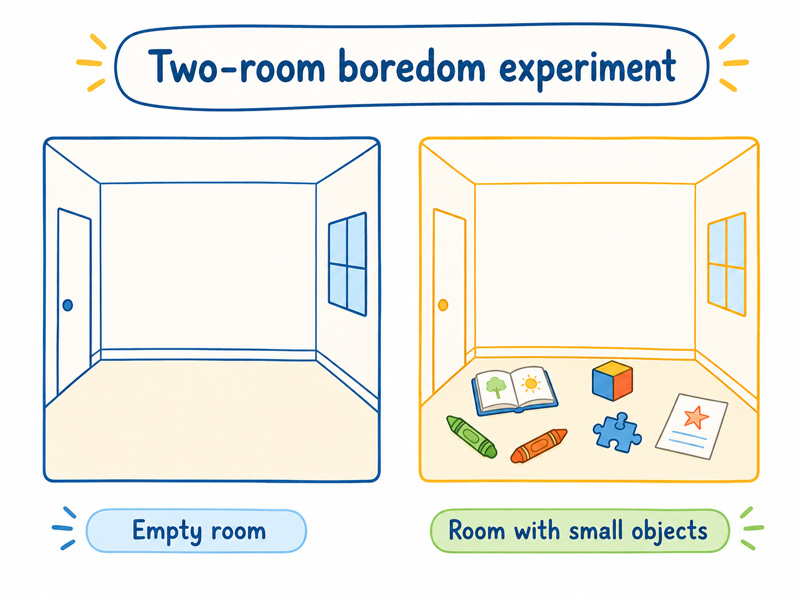
The people in the interesting room reported significantly more boredom than the people in the empty one.
Boredom, on this account, is not a property of what you are doing. It is a comparison. Your mind is constantly weighing the current activity against whatever else is available, and it registers boredom when the current thing loses. Put a tablet on the table, switched off, untouched, just present, and every activity in the room is now being measured against it.
This is why “you can have it after you finish” so often backfires. It does not remove the comparison. It sharpens it.
What this means for an afternoon at the kitchen table
A few things follow, none of them dramatic.
- Out of sight, not just out of use. If the tablet is in another room, the comparison gets quieter. This is not about willpower, yours or theirs. It is about what is available.
- Expect a shape, not a duration. Attention comes in waves. A child who drifts at minute five and comes back at minute eight has not failed at anything.
- Let them choose the thing. Self-chosen activities routinely outlast assigned ones by a wide margin. If your child picks the page, you have already done most of the work.
- Stop early, on purpose. Ending while there is still interest left makes coming back easier. Ending in frustration teaches that the activity ends in frustration.
- Notice what already holds them. Every child has something they lose track of time inside: a specific kind of drawing, a specific kind of building. That is their real attention span. The worksheet is not.
If you are teaching at home, the same distinction decides the shape of the morning: how long a homeschool day actually needs to be.
And if you are genuinely concerned, if focus is a struggle at home and at school and your child seems frustrated by it themselves, that is a conversation for your pediatrician or your child’s teacher, not for an article. Nothing here is a screening tool.
Common questions
Is it normal for a 5-year-old to lose interest after five minutes?
Yes, especially with an activity they did not choose. Attention in early childhood arrives in waves rather than in one continuous block, and interest level changes the picture more than age does.
Does screen time shorten a child’s attention span?
Research shows a modest and inconsistent relationship between screen time and attentional control, and most of it is correlational, which means it cannot establish cause. The clearer effect is on comparison: an available screen makes other activities feel more boring by contrast.
How can I help my child concentrate for longer?
Remove the competition rather than adding pressure. Let them choose the activity, keep other options out of sight, and end sessions before frustration rather than after. Longer stretches tend to follow from that, not from being asked for.
Activity books made to be finished
Colouring pages, puzzles, fun facts, activities and creative challenges for kids!
Browse the books→Sources
- Willingham, D. T. “Ask the Cognitive Scientist: Do Today’s Kids Have Reduced Attention Spans?” American Educator, American Federation of Teachers, Spring 2026. Adapted from Education Next, September 2025.
- Andrzejewski, D., Zeilinger, E., & Pietschnig, J. “Is There a Flynn Effect for Attention? Cross-Temporal Meta-Analytical Evidence for Better Test Performance (1990–2021).” Personality and Individual Differences, 216 (January 2024): 112417.
- Struk, A., et al. “Rich Environments, Dull Experiences: How Environment Can Exacerbate the Effect of Constraint on the Experience of Boredom.” Cognition and Emotion, 34, no. 7 (2020): 1517–1523.
- “Capacity for Study in Children.” The Sanitary News, May 1881.
Keep reading


Come along for the day-to-day.
Every idea here has something you can print to go with it, and a few that we put between covers.
Our activity books put all of this in one place. See the books →