Handwriting practice that doesn’t feel like homework

Short, purposeful, and about something. Three lines of letters written to make a real label beats a full page of the letter b written for no reason, and the difference is not motivation. It is that one has a point and the other does not.
Two things are worth getting straight before the practical part: what the evidence on handwriting actually says, and what to do about your child’s grip. The second one is probably not what you have been told.
Leave the pencil grip alone
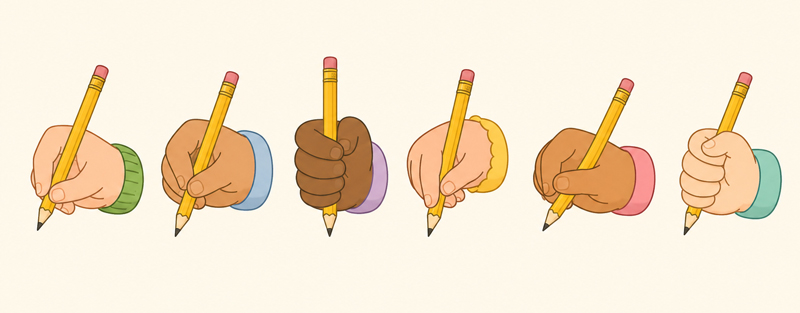
The dynamic tripod (thumb, index, and middle finger, with the pencil resting on the middle finger) has been taught for decades as the correct grip, and children who do not adopt it are often corrected.
The evidence does not support that.
In a 2012 study, researchers videotaped 120 typically developing fourth-graders during a writing task, categorized the grips they used, and assessed their writing for speed and legibility. They found six distinct grip patterns. Grip made no significant difference to either speed or legibility. A follow-up looking at grip forces found no meaningful differences between the mature grasp patterns either.
The authors’ conclusion was blunt: alternative grips may be perfectly acceptable for fast, legible handwriting, and interventions should focus on letter formation and speed rather than on grip.
So unless a child is in pain, tiring unusually fast, or their writing is genuinely illegible, an unusual grip is not a problem to fix. In those cases the person to talk to is their teacher or an occupational therapist. Correcting a grip costs you something real: it makes writing feel like a thing they are doing wrong.
Does handwriting still matter?
Probably yes. The evidence is suggestive rather than settled, and it is worth being accurate about that, because this is a topic where confident claims outrun the data.
The study everyone cites is from 2024: researchers in Norway recorded high-density EEG from participants writing words with a digital pen versus typing them, and found far more elaborate connectivity patterns during handwriting, in brain regions and frequencies associated with memory formation. It was widely covered.
It also drew a published critique the following year from researchers at the Basque Center on Cognition, Brain and Language and Aix-Marseille University, who raised methodological concerns and questioned whether the conclusions follow from the data.
And a detail that most coverage omitted: the participants were 36 university students, not children. Applying the finding directly to a six-year-old learning letters is an extrapolation, not a result.
What can be said reasonably: forming a letter by hand involves a different and more varied set of movements than pressing a key, and there is a body of work suggesting benefits for letter recognition and recall. That is a decent reason to keep handwriting in a child’s week. It is not a reason to panic about keyboards.
What makes practice fail
- Volume. A full page of one letter is the standard format and the worst one. Handwriting is physically tiring, quality degrades as the hand fatigues, and a child practicing a letter badly for the second half of a page is practicing it badly.
- No purpose. Letters written for the sake of letters have no reason to be good. A child who cannot see why the writing exists has no internal standard to write to.
- Correction during. Pointing out a badly formed letter while they are mid-line stops the flow and makes the whole activity feel supervised.
- Too long. Five to ten minutes. Beyond that you are training fatigue.
What works instead
Give the writing a job. Labels for a drawing. A list for the shopping. A note left on somebody’s pillow. A sign for a bedroom door. Writing that a real person will read has a built-in standard.
Three lines, not a page. Then stop, regardless of how it is going. Stopping while it is still going well is the whole technique, the same principle as ten minutes of coloring, every day.
Praise one letter, not the line. That b is a good one. Specific, true, and it gives them something to aim at next time. “Well done” gives them nothing.
Work on formation, not appearance. Whether a letter starts at the top and moves in the right direction matters more than whether it is pretty. Bad formation gets slower and messier under time pressure years later; slightly wobbly but correctly formed letters do not.
Say the letter out loud while writing it. Free, and it links the shape to the sound rather than leaving it as a drawing exercise.
Bigger first. Large letters on unlined paper, then lined. Small letters demand control that has not developed yet, and demanding it early produces frustration rather than progress.
If you are teaching at home, keep the practice inside the day rather than stretching the day around it: how long a homeschool day actually needs to be.
When they hate it
Some children resist handwriting specifically, and hard.
Stop the practice and change the medium for a while. Chalk on the pavement, a finger in a tray of flour, a wet paintbrush on a fence, letters cut out of paper. All of it is letter formation and none of it is a worksheet.
Also worth checking: hand fatigue, which is easy to miss because children rarely describe it. If they are gripping hard, pressing hard, or shaking out their hand, the sessions are too long before they are too difficult.
And if handwriting is a struggle across settings, at home and at school, and your child is frustrated by it themselves, that is a conversation for their teacher, not for an article.
Common questions
Should I correct my child’s pencil grip?
In a typically developing child, probably not. Research on fourth-graders found that grip pattern had no significant effect on handwriting speed or legibility. Pain, unusual fatigue, or genuinely illegible writing are reasons to consult a teacher or occupational therapist.
How long should handwriting practice be?
Five to ten minutes, three lines rather than a full page. Handwriting is physically tiring, and quality drops as the hand fatigues, and a long session mostly practices the tired version.
Does handwriting matter now that children type?
The evidence suggests forming letters by hand supports letter recognition and recall, though the most-cited recent brain study has drawn published methodological criticism and was conducted on university students rather than children. Keeping handwriting in the week is reasonable; alarm is not.
Activity books made to be finished
Colouring pages, puzzles, fun facts, activities and creative challenges for kids!
Browse the books→Sources
- Schwellnus, H., Carnahan, H., Kushki, A., Polatajko, H., Missiuna, C., & Chau, T. “Effect of Pencil Grasp on the Speed and Legibility of Handwriting in Children.” American Journal of Occupational Therapy, 66, no. 6 (2012): 718–726.
- Van der Weel, F. R., & Van der Meer, A. L. H. “Handwriting but Not Typewriting Leads to Widespread Brain Connectivity: A High-Density EEG Study with Implications for the Classroom.” Frontiers in Psychology, 14 (2024): 1219945.
- Pinet, S., & Longcamp, M. “Commentary: Handwriting but Not Typewriting Leads to Widespread Brain Connectivity.” Frontiers in Psychology, 15 (January 2025): 1517235.
Keep reading



Come along for the day-to-day.
Writing practice sheets, free to print. Our books include them alongside everything else.
Our activity books put all of this in one place. See the books →